
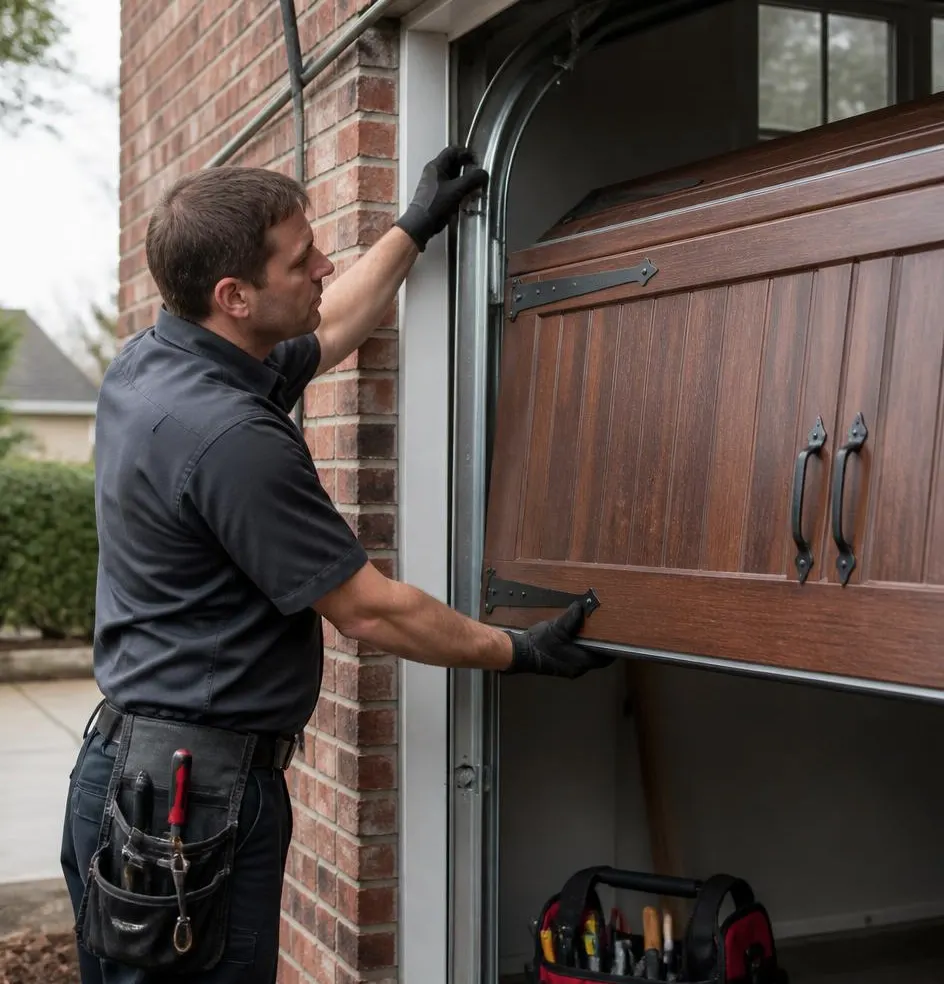
The Mistake Most People Make First
The power goes out during an afternoon storm, or the opener stops responding, and the first instinct is to reach up and yank the red emergency release cord. It feels like the obvious fix — it's right there, it's labeled for emergencies, and pulling it seems harmless. Most of the time it is. But that cord doesn't make the door lighter or safer to move. It just disconnects the door from the opener's motor and lets gravity, springs, and your own arms take over completely. If something else is already wrong — a broken spring, a bent track, a door that's been swelling in the humidity and binding against the frame — pulling that cord removes the one thing that was holding the door in a controlled position.
What the Cord Actually Does
Every residential garage door opener has a trolley that rides along a rail and connects to the door through a release mechanism, usually a bright red handle hanging on a rope or cord. Pulling it disengages the trolley so the door can be raised and lowered by hand, independent of the motor. It's meant for exactly two situations: a power outage when you need to get the car out, or an opener that has failed mechanically and needs to be bypassed temporarily. In both of those cases, a properly balanced door with healthy springs will lift smoothly with one hand and stay roughly where you put it.
What Goes Wrong
The trouble starts when the springs are no longer doing their job. A torsion or extension spring that's cracked, stretched, or already broken can no longer counterbalance the door's weight. The opener's motor, straining but still connected, may have been the only thing keeping the door from slamming down. Disconnect that link with the release cord and a door that weighs well over a hundred pounds can drop in under a second. That's enough force to crush fingers, break a wrist, or come down hard on a pet, a toy, or a car bumper. It also tends to bend tracks and crack panels on the way down, turning a spring problem into a multi-part repair.
There's a second, slower-motion version of this mistake that's common here in Southwest Florida. Humidity swells wooden and composite door panels, and salt air near the coast speeds up rust on rollers, hinges, and the release mechanism itself. A door that's dragging or sticking in its tracks because of swelling or corrosion may feel stuck when you try to operate it manually after pulling the cord. People respond by forcing it, which can snap cables, pop rollers out of the track, or warp the frame further. The release cord isn't a diagnostic tool — it doesn't tell you why the door isn't moving, it just removes the motor from the equation.
How to Tell Before You Pull It
A few quick checks take less time than the repair you'd avoid:
- Look at the springs. Torsion springs sit on a shaft above the door opening; a visible gap in the coil means it's broken. Extension springs run along the horizontal tracks; look for a stretched, disconnected, or sagging spring.
- Watch how the door moves before disconnecting anything. If the opener struggles, grinds, or reverses on its own before you touch the cord, that's a sign of spring or balance trouble, not just a motor issue.
- Check for visible track damage. Bent rails, rollers hanging loose, or a door that sits crooked in its opening all mean the door is not safe to lower by hand, cord or no cord.
- If the door is already open when the power goes out, pulling the cord to close it by hand is usually fine as long as it moves smoothly and evenly on both sides. If it's heavy, uneven, or won't stay put partway, stop and support it rather than letting it travel.
If You Do Need to Use It
For a genuine power outage with a door in good working order: pull the cord straight down, not at an angle, to avoid putting side stress on the trolley. Lift or lower the door slowly and evenly, using both hands if it's a double-wide door. To reconnect, run the opener through a normal cycle after power returns — it should re-engage the trolley automatically. If it doesn't catch, don't force the mechanism; that's a sign something in the release hardware needs attention.
After any storm-related power outage, it's worth giving the cord, pulley, and trolley a visual check for rust or salt residue, especially if you're closer to the water. A cord that's stiff, frayed, or corroded won't release cleanly when you actually need it.
When to Call Cape Coral Garage Door
If you've pulled the release cord and the door won't lift smoothly, feels uneven, or dropped on its own, stop operating it and call us. That's almost always a spring problem, and our Spring Replacement service handles it safely with the right tension equipment — not something to troubleshoot by hand. If the issue showed up during or right after a storm, our Emergency Garage Door Service covers after-hours calls across Cape Coral, Fort Myers, and the surrounding areas, so you're not stuck with a door you can't trust overnight.
If you're dealing with a stuck or uneven garage door in Cape Coral, FL, call Cape Coral Garage Door for a fast, honest diagnosis before anyone gets hurt trying to force it open.