
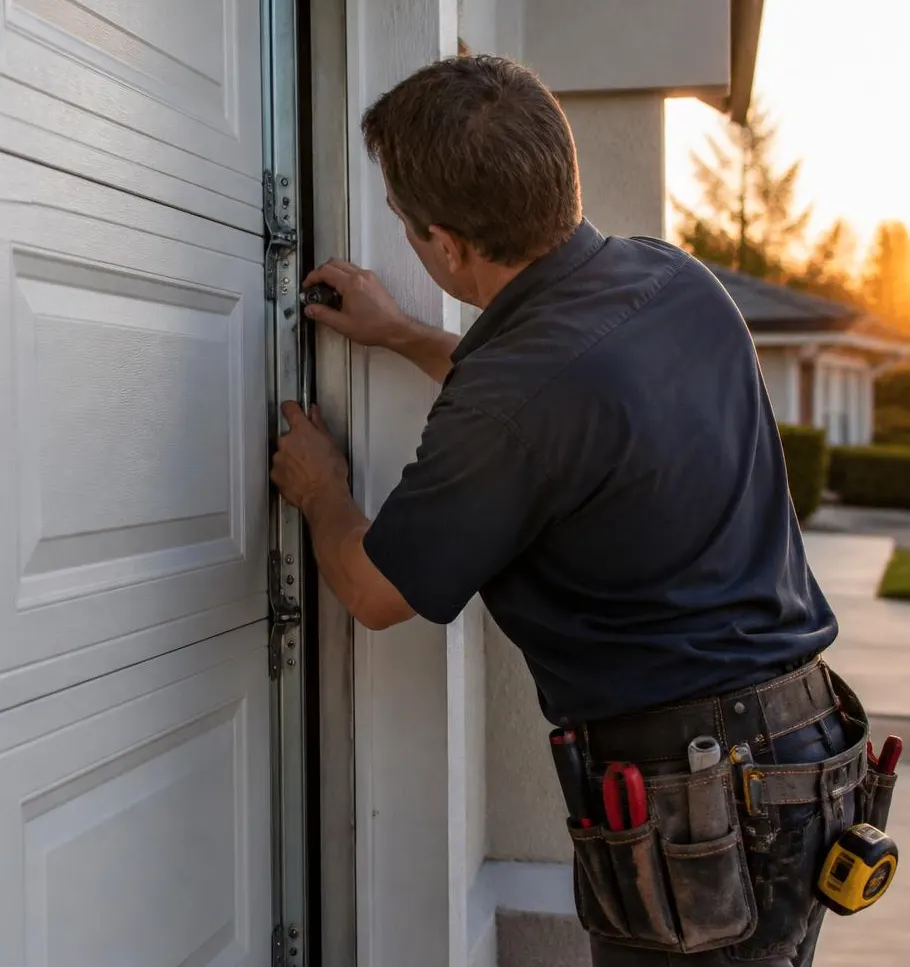
What a Technician Sees on a Typical Call
Most calls about a garage door that won't open follow a familiar pattern in this area. The homeowner presses the remote and nothing happens, or the opener hums but the door doesn't move, or the door lifts a few inches and stops. Sometimes it's tied to a recent afternoon downpour or a power blip from a storm. Sometimes the door worked fine yesterday and today it's dead silent. The symptoms point to different problems, and a technician works through them in a specific order because it saves time and avoids guesswork.
Common Symptoms Homeowners Report
- Opener light turns on, but the door doesn't move
- Door opens partway, reverses, or stops
- Complete silence from the opener, no lights, no sound
- Door feels unusually heavy when lifted by hand
- Grinding, clicking, or straining noise with no movement
- Remote works intermittently or only up close
The Order a Technician Checks Things
1. Power to the Opener
This is the fastest check and the most overlooked. Garage circuits here are often on GFCI outlets, and humidity or a power surge from a storm can trip them. A technician checks the outlet, the breaker, and whether the opener is actually plugged in before touching anything mechanical.
2. The Remote and Wall Control
Dead batteries, a remote that's lost its programming after a power outage, or a wall button with a loose wire are all checked next. It's a two-minute test that rules out the simplest cause.
3. The Safety Sensors
The small photo-eye sensors near the bottom of the track have to be aligned and unobstructed, or the opener won't let the door close or, in some cases, operate at all. Humidity and condensation can fog the lenses, and a knock during yard work or storm debris can nudge them out of alignment. Realigning and cleaning them resolves this quickly.
4. Manual Operation and the Springs
With the opener disconnected, a technician lifts the door by hand. If it's heavy, won't budge, or drops suddenly, the torsion or extension springs have likely failed. Springs in this climate go through constant expansion and contraction from heat and humidity, and that cycling shortens their lifespan compared to drier regions. A broken spring is not a DIY repair, the door is under heavy tension and the fix means a full spring replacement with the correct size and wind for the door's weight.
5. Cables and the Track
Frayed or slipped cables, along with a track that's bent, rusted, or knocked out of alignment, come next. Salt air near the coast accelerates rust on tracks and hardware, and swelling from moisture can cause a wood-composite door to bind. The fix ranges from re-seating a cable to replacing a section of track.
6. The Opener Motor and Gears
If the opener hums but the door doesn't move, the internal drive gear, often plastic, may have stripped. This happens gradually, so a grinding noise beforehand is a common warning sign. Depending on the opener's age, this is either a gear replacement or a sign it's time for a new unit.
7. The Emergency Release Cord
Last but worth checking: the red release cord can get bumped or accidentally pulled, disconnecting the door from the opener entirely. Reconnecting it is quick once spotted.
When to Call Cape Coral Garage Door
If the door won't budge by hand, that's a spring problem and not something to force. Call for Spring Replacement rather than attempting it yourself. If the opener hums, clicks, or stays silent after you've checked power and batteries, that points to a motor or gear issue, which falls under Garage Door Opener Repair & Installation. And if this happens during a storm, after hours, or right before you need to leave, our Emergency Garage Door Service covers Cape Coral, Fort Myers, North Fort Myers, Lehigh Acres, Pine Island, Estero, Bonita Springs, and Sanibel.
If your garage door in Cape Coral, FL won't open, call Cape Coral Garage Door. We'll diagnose it on the spot and get it moving safely.